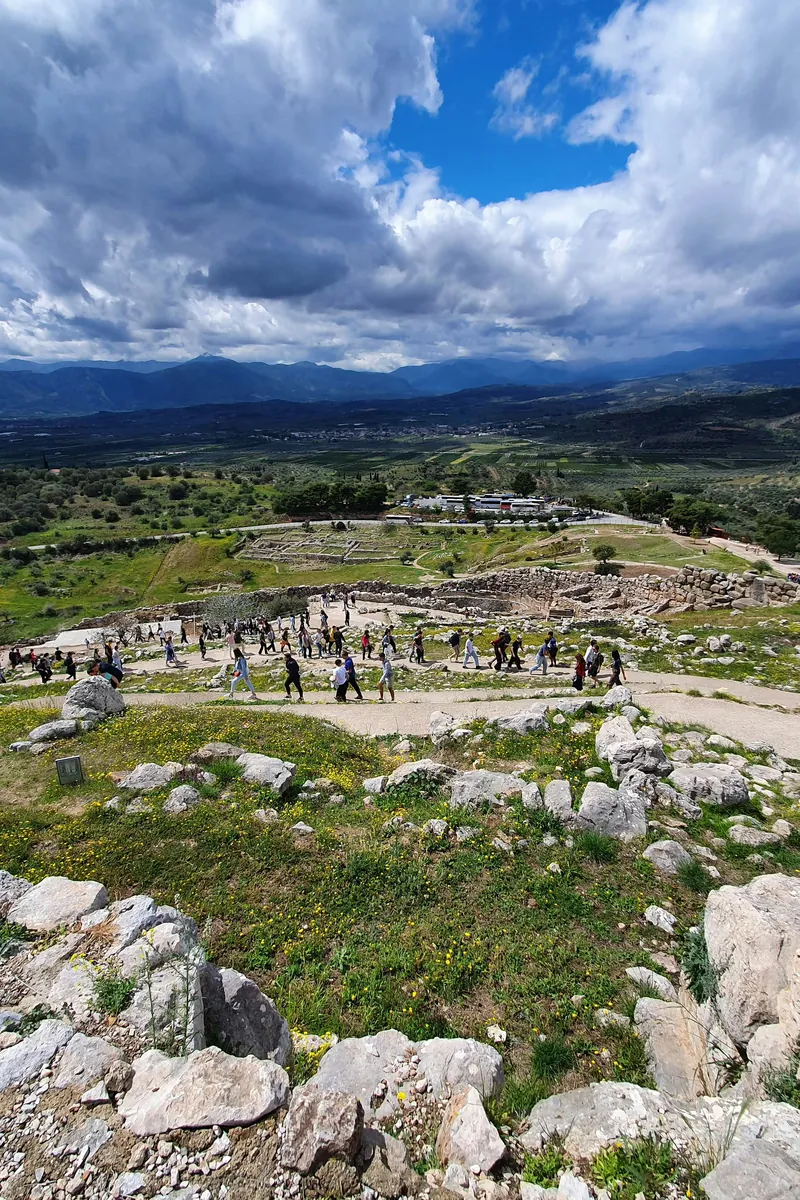
The Archaeological Site of Mycenae is the great fortified citadel of the Argolid, the stronghold that gave its name to an entire age — the Mycenaean civilisation that dominated the Greek mainland in the Late Bronze Age, roughly 1600 to 1100 BC. Set on a rocky hill between two peaks about 90 minutes south-west of Athens, it was the richest and most powerful centre of its world, the place Homer called 'rich in gold' and named as the seat of King Agamemnon, leader of the Greeks against Troy. Since 1999 it has been a UNESCO World Heritage Site, inscribed together with the neighbouring citadel of Tiryns.
What you walk up to today is the excavated heart of that Bronze Age kingdom, entered through the famous Lion Gate — its pair of carved lionesses the oldest monumental sculpture in Europe — set into walls of stone so massive that later Greeks believed only the one-eyed giants, the Cyclopes, could have raised them. Within the walls lie Grave Circle A, the royal shaft graves where Heinrich Schliemann uncovered the golden death-masks that made Mycenae world-famous, among them the so-called Mask of Agamemnon; the ruins of the palace with its great hall on the summit; and a secret underground cistern reached by a stairway cut deep into the rock. A short walk downhill stands the Treasury of Atreus, the vast domed 'beehive' tomb also known as the Tomb of Agamemnon.
Mycenae lies in the Argolid, in the north-eastern Peloponnese, an easy drive from Athens, Corinth or Nafplio and often paired with the theatre of Epidaurus in a single day. The finest treasures excavated here — the gold masks, the inlaid daggers, the Warrior Vase — are kept in the National Archaeological Museum in Athens, while the Archaeological Museum of Mycenae beside the citadel displays the finds that bring the site itself to life. Your combined ticket covers all three parts on the hill: the citadel, that museum and the Treasury of Atreus. We handle the ticketing in your own language and reserve your entry for the date you choose, so you can give your attention to the legend rather than the line.